


By Md. Saddam Hossain Roni, Rotaract Club of Dhaka Orchid, Bangladesh
When our Rotaract family lost one of its own, we turned heartbreak into a mission of hope. Talk Hope, Bangladesh’s first 24/7 emotional support line, led by youth from our club and community, has brought understanding and compassion as we address the vital issue of mental health. It was an awakening for us of the silence that can mask emotional pain, and the opportunity to help by creating a place for people to talk, get help, and find hope. It has sparked a national conversation about mental health.
On 27 February 2024, I received a call that no Rotaract leader ever wants to hear. One of our members from the Rotaract Club of Dhaka Orchid had taken his own life.
He wasn’t just any member, he was one of the brightest, most passionate souls in our club. He played a vital role in organizing Bangladesh’s first-ever rock concert by a Rotaract Club, held in June 2023, which drew over 12,000 youth and was lauded as an innovative approach to youth engagement.
His loss shook us to the core. The joy we had created for others suddenly felt incomplete. For the first time, I realized how silent the battle with mental health can be, even among those who seem the happiest.
Silence became our call to action
In the weeks that followed, our club members struggled to make sense of what happened. We talked about how often people hide their pain behind smiles, how we had missed the signs, and how so many others must be silently suffering.
That’s when the idea of Talk Hope was born. As Rotaractors, we’ve been taught to serve with compassion. This time, service began with listening. We wanted to create a space where people could talk about their pain safely, without judgment. A space where a conversation could save a life.
A need to be heard
We collaborated with SHADOW (Society for Humanity And Development Over the World) and its parent organization, the Dr. Muhammad Fakhrul Islam Foundation, to launch Talk Hope exactly two days after the date of our friend’s passing. To our knowledge, it is Bangladesh’s first and only fully free, 24/7 suicide prevention and mental health awareness platform. We started with an awareness platform. But within a year, we had added a call center, a virtual support center, and two in-person counseling centers staffed with professional psychologists. All of our services are completely free.
Within just a few months, thousands of young people reached out through calls, texts, and social media. Some were struggling with depression. Others were facing pressure from studies or relationships. But they all shared one thing, a need to be heard.
Though I am an engineer, I have started to study psychology and have even published a few journals. In collaboration with the Bangladesh Psychological Association, our Rotaractors received training from professional psychologists on how to become “listeners.” We learned that empathy doesn’t always mean solving someone’s problem. Sometimes, it simply means sitting beside their pain without judgment.
The power of youth leadership
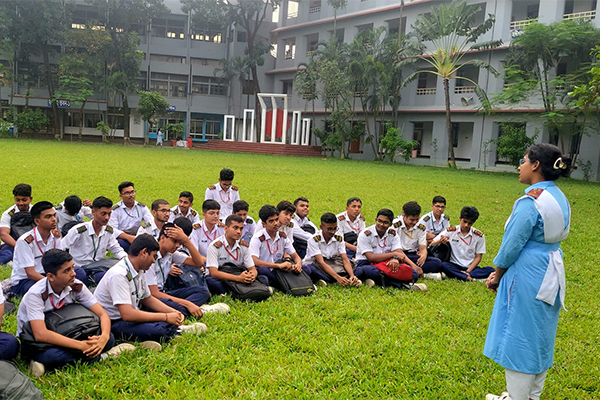
One of the most inspiring leaders to emerge from this work is Interactor Suhana Rahman Shukonna. At 16, she threw herself into school outreach, peer counseling, and child-focused awareness programs. Her energy helped us bring emotional literacy sessions into classrooms, where students learned to speak about feelings instead of hiding them.
Shukonna was nominated for the KidsRights International Children’s Peace Prize in 2024. She didn’t win but has been nominated again this year. This commitment to mental health demonstrates how youth leadership can make an impact both locally and globally. When I see her lead workshops or speak with students, I’m reminded of how Rotary’s youth programs are shaping the next generation of changemakers.
Beyond a helpline: a movement
Talk Hope has now evolved beyond just a helpline. It’s become a national youth movement for mental wellness. We organize community dialogues, awareness campaigns, and online education programs about emotional health.
In alignment with Rotary’s current global priorities, especially a focus on mental health, our initiative reflects how Rotary youth programs transform compassion into action. The Rotaract Club of Dhaka Orchid continues to pioneer unique projects in Bangladesh that exemplify Rotary ethics, innovation, and service to humanity.
Every time someone tells us, “Your team helped me hold on,” we silently dedicate that moment to the friend we lost, because he is the reason this mission exists.
Looking ahead
We dream of expanding Talk Hope into a nationwide support ecosystem. Our goal is to make the helpline toll-free and to open youth-friendly wellness centers in universities, with the help of Rotary partners and psychologists.
What began with grief has become something that drives us. We learned that mental health is central to human dignity. When service meets empathy, miracles happen.
If our story inspires you, share it with someone, start a conversation around mental health, or simple check in on someone today. Sometimes, a small act of kindness can save a life.
About the author: Md. Saddam Hossain Roni is a multiple Paul Harris Fellow and charter president of the Rotaract Club of Dhaka Orchid, Bangladesh. He is the founder of Talk Hope and SHADOW, and has served as president of the Rotary Interact Alumni Association of South Asia and as an Interact Representative for District 3282.
The World Health Organization recognizes 10 October as World Mental Health Day. Learn more about how members of the Rotary Action Group on Mental Health Initiatives strive to improve the mental health of communities and build friendships.
https://blog.rotary.org/2025/10/16/talk-hope-launches-a-conversation-about-mental-health/