


By Vicki Puliz, Rotary Foundation Trustee and member of the Rotary Club of Sparks, Nevada, USA
A few months ago, I traveled a difficult, muddy road to a remote community in the Copan region of western Honduras. When our vehicle began to slip towards a steep drop, we continued on-foot to a gathering under a shade structure at the top of the hill, where a few women conversed, and children played. Beyond, I could see foot paths leading to small dwellings scattered around.
In Honduras, 1.5 million people lack access to safe drinking water or sanitation facilities. The lack of clean water is especially prevalent in rural areas, where women and children often collect water from streams or open wells, sources also used for bathing, washing clothes, and where animals defecate. This leads to widespread illness and disease.
I was in the country to be part of community meetings to discuss completed water systems provided by a Rotary Foundation global grant. The US$800,000 project was led by the Rotary Club of Santa Rosa de Copan in Honduras and the Rotary Club of Sacramento, California, USA, and joined by every club in Rotary District 5180, along with several other districts and a partnership with World Vision USA. The project benefited 7,000 people in 13 communities, 10 schools, and 5 healthcare units in western Honduras. But the project became more than numbers to me.
Changing lives
With the help of an interpreter, the community members shared what life was like before water was brought to the village, how they took part in the project, and how their lives were improved with access to clean water.
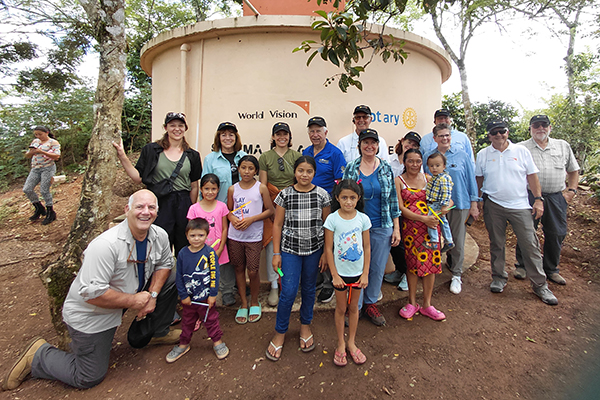
We then trekked up another hill — to see a 10,000-gallon tank, marked with logos from Rotary and World Vision. Children raced past me in flimsy shoes while I struggled not to slide down the muddy incline. I found it striking how difficult it was to simply fetch water in this environment. Women and children spent hours each day collecting water, which meant that many children missed school, as they were needed to help their families accomplish the task of having water.
At the top of the hill, we admired the tank that captured the water from the pipes laid in the trench. The five miles of trench was dug by hand by the villagers from a protected spring high in the mountains. Sand cushioned the PVC pipe which delivered the water moved solely by gravity to the holding tank, and then to 30 homes — clean water for each family. For drinking, cooking, bathing, and even a toilet.
We met Nando, a quiet, wrinkled man who carried himself with purpose. He was the plumber. After training from World Vision, Nando maintained this lifesaving system that brought water to the village, and he was also the head of the water committee. The committee collected $2 per month from each household to cover parts and repairs, a significant amount for subsistence farmers who face frequent droughts and limited job opportunities.
Nando and the other community members expressed deep pride in their contribution to the project — the monthly fee and the physical work which included hard labor to dig the trenches and lay the pipe. The commitment to take care of this water system as their own was clear. This was not charity; this was support with dignity and respect for people who wanted to be empowered to improve their own lives and those of their children.
Over the next two days, we visited four more villages.
After meeting in the next village, we walked to the small school, past abandoned outhouses, and examined the new toilets along with a separate hand-washing station. The new block included a toilet for boys, one for girls, and one with a shower for those with disabilities and other needs.
Carlos, a 9-year-old student, showed me his classroom, where the children taught me a song about washing our hands. These children now have clean water to drink. They no longer suffer from diarrhea which had been common before the water system was installed. Their school has usable toilets and girls can stay in school even after they start menstruation.
These children have a brighter future because of The Rotary Foundation. The efforts of Rotary members and the contributions of generous donors provide a starting point and a path to self-sufficiency within these communities. By listening and responding to their needs, we help create a better life for them.
How can you help?
If you’re a member of a Rotary club, learn the ways you can participate in our Foundation and encourage other members to do so. Invite them to contribute their time, talent, and treasure to projects that change lives for the better, to meet people like Carlos or Nando, and enjoy the fulfillment that comes from making a difference. If you aren’t yet a member, find a club near you, and join us.
Together, we can create a future that builds hope, connection, and impact, while we transform lives and empower others toward self-sufficiency.
Adapted from a speech Vicki Puliz delivered to incoming Rotary leaders at the International Assembly in Orlando, Florida, USA in January. View or download the full speech from the Brand Center.
https://blog.rotary.org/2026/02/26/honduras-water-project-demonstrates-power-to-build-self-sufficiency/