


by Klenam Fiadzoe, Rotary Club of Accra-South, Ghana
In recent years, the climate crisis has shifted from a distant threat to a reality for many Ghanaians. From recycled clothing waste strangling our coastlines to the increasing unpredictability of our rainfall seasons, the environment is no longer a peripheral issue; it is the foundation of our survival.
Ghana’s environment is under siege from multiple fronts: illegal mining which pollutes its bodies of water, deforestation, and a staggering plastic and textile waste crisis.
In the heart of Accra, a global secondhand clothing trade converges at the Kantamanto Market (Kanta), perhaps the most significant resale and up-cycling ecosystem in the world, sitting at the tail end of a linear “fast fashion” economy that produces far more than the world can consume. Kanta is home to more than 30,000 individuals processing and trading over 25 million garments monthly. While this creates an incredible resale economy, the “linear” fallout is devastating: 40% of these clothes end up as waste, choking gutters, polluting water bodies, and forming “textile tentacles” along Accra’s beautiful beaches.
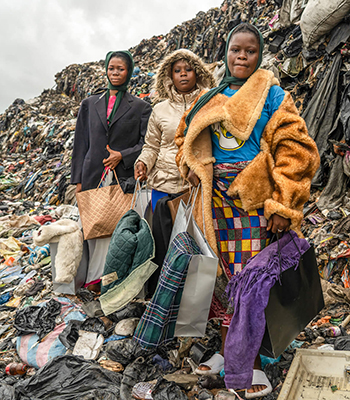
Local activists have began to fight back. Since 2016, Yayra Agbofah’s The Revival has empowered craftsmen and students to breathe new life into textile waste, proving that “trash” can be couture. Meanwhile, Emmanuel Aggrey-Tieku’s BALEBOARDS project turns mountains of discarded fabric into massive public installations. Together, these activists are forcing a global reckoning: What are we wearing, where does it really go, and who pays the price for our fast fashion?
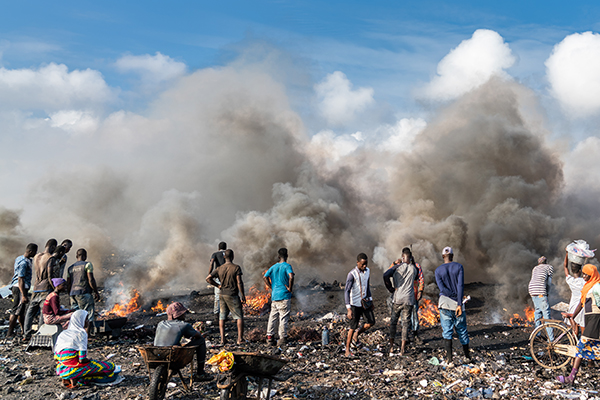
E-waste in Ghana — particularly in hubs like Agbogbloshie — exacts a devastating toll on the environment. Approximately 99% of this waste is managed by an informal sector comprising unlicensed collectors, intermediaries, and scrap dealers. Because these workers rely on manual disassembly and open-air burning to recover materials, the process results in severe heavy metal contamination of soil and water. Furthermore, it poses significant health risks to the community, including respiratory illnesses and neurological damage.
Engineering a sustainable city requires a fundamental shift toward a circular economy. The Or Foundation is addressing critical systemic gaps by developing fashion waste infrastructure and pioneering research into microbial degradation for synthetic-natural textile blends and plastic polymers. Furthermore, their use of bioremediation technologies aims to reclaiming one of the most polluted water bodies in the world: Korle Lagoon.
Their holistic approach addresses the systemic roots of the waste crisis through:
- Environmental Restoration: Hauling over 18 tons of textile and plastic waste from Accra’s beaches weekly and monitoring “textile tentacles” across a seven-kilometer swath of our coastline.
- Waste Diversion: Collecting textile waste from throughout Kantamanto and ensuring it reaches sanctioned dumpsites far from our fragile water bodies.
- Social Equity & Empowerment: Transitioning the market community from “crisis mode” into long-range planning. This includes a paid apprenticeship program that offers young women alternative career pathways away from the dangerous labor of carrying 55kg clothe bales.
- Localized Innovation: Building R&D infrastructure to sort and process industrial-scale clothing waste using machinery designed and manufactured locally from scrap metal.
- Entrepreneurship: Operating a Business Incubator that provides catalytic seed funding to local visionaries.
Where Rotary can help
Rotary continues to be a viable partner on environmental concerns, partnering on actions that strengthen the conservation of natural resources and advance ecological sustainability. Rotary’s global network of volunteers take action in communities to embrace local solutions, create innovative service projects, and access the resources necessary to foster harmony between humanity and nature.
The Community Action for Fresh Water initiative, a collaboration between Rotary International and the United Nations Environment Programme, offers a framework to engage and empower communities.
While our cities grow and our ecosystems face unprecedented pressure, our environment demands an enduring, sustained, collective commitment. We must pursue strategic collaborations that can scale our efforts to restore freshwater, coastal and forest ecosystems, tackle legacy waste, and redouble our efforts to clean up, plant trees, fund local environment initiatives, and utilize our professional networks to push for stronger regulations.
Rotary’s Environment Month serves as a reminder: whatever happens to the beaches of Accra or the waters of the Korle Lagoon resonates far beyond our borders. We are not merely protecting nature; we are safeguarding our health, our economy, and the planet.
https://blog.rotary.org/2026/04/27/combating-textile-electronic-waste-in-ghana/