


By Eve Conway, 2023-25 Rotary International Director
Travelling in a convoy of four-wheel drive safari vehicles along unmade sandy roads, we went deep into a rural area outside Lusaka, the capital of Zambia. Leaving clouds of sand behind us, we were heading towards Central Province on World Malaria Day to see the campaign aimed at eradicating this disease in Zambia in action.
After a long two-hour, hot and bumpy ride on potholed, uneven roads — where we were viewed with wonder by local villagers and suspiciously by a large elephant who headed towards us angrily but then thankfully stopped — we were taken to the palace of Chief Chamuka of the Lenje people in Chisamba District, Central Province.
He is a key supporter of the malaria eradication campaign and chair of the Central Province End Malaria Council. As the chief entered, we kneeled and clapped and addressed him as “His Royal Highness.”
After that, it was time to be taken to where the World Malaria Day celebrations on 25 April were taking place, covered by Zambian TV News. The theme of the day’s activities was “Driven to End Malaria: Now We Can. Now We Must.” The day included a community vote of thanks, updates on the country’s malaria progress, regional insights from Chief Chamuka, district-level programme highlights, and congratulations from and future efforts shared by 2025-26 Rotary Foundation Trustee Chair and past RI President Holger Knaack.
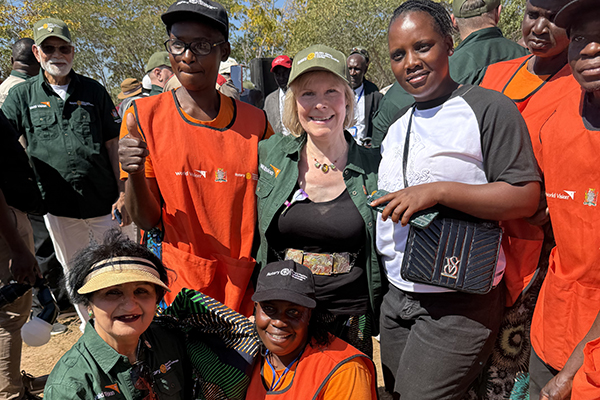
This is where we met those at the centre of making this campaign a success — the community health workers. It was a highlight of the day for me and a special Rotary moment to be able to talk with them and thank them for their work.
I was one of a small group of Rotary members (Arch Klumph and Legacy Society members) from across the world invited on a Donor Impact Visit by Holger to see first-hand the progress of this campaign.
The Programs of Scale grant, announced in February 2021, provided $2 million from Rotary International to Partners for a Malaria-Free Zambia, a member-led program focused on fighting malaria. World Vision U.S. and the Gates Foundation are also involved in malaria mitigation efforts and each contributed $2 million to the programme. This $6 million program aimed to train and equip 2,500 community health workers in Zambia to support the government’s work to eradicate malaria in that country.
A mosquito bite is all it takes for malaria to spread
The 2021 Programs of Scale award recipient, implemented in 2021-24:
- Aimed to reduce severe illness and death from malaria in 10 districts in two provinces
- Sought to reach more than 1.25 million people with prevention information, testing, and treatment
- Was based on a community health worker model with proven success
- Was designed to strengthen the health system.
During the World Malaria Day event, we heard that Zambia has recorded notable progress in the fight against malaria with cases dropping from 279 per 1,000 people in 2021 to 213 per 1,000 people in 2025. Partners for a Malaria-Free Zambia has contributed to this success by training, equipping, deploying, and integrating 2,500 community health workers.
Later, I had the opportunity to sit down with Martha Lungu, Executive Director of Malaria Partners Zambia and member of The Rotary Foundation Cadre of Technical Advisers. A member of the Rotary Club of Ndola, she described how the campaign is centred around community health workers and its impact is continuing.
This first Program of Scale grant has used a proven community health worker model, in which public health workers connect people with care and social services. The workers have been trained and equipped to test and treat malaria closer to people’s homes, so people don’t have to travel to a health clinic. This reduces severe cases and deaths from the disease.
The program has trained 2,500 volunteer community health workers, with most of them learning to provide services related to malaria, diarrhea, and pneumonia in an area of 500 people. Thanks to these workers, more than 1.25 million people have improved access to malaria testing and treatment in their communities. Two years after the end of the grant-funded program, 94% of the community health worker roles remain filled, and the workers conducted 42% of testing in the 10 districts.
Community health workers detected 58% of all confirmed cases in the 10 districts. They treated 97.5% of the cases they detected and referred the remaining 2.5% of cases to health facilities.
Scaling up
This program has been scaled up to Create Lasting Impact as it has also led to an opportunity to capitalize on Rotary’s strategic partnership with the Gates Foundation and World Vision to create the Rotary Healthy Communities Challenge, aimed at preventing and treating disease. It is being implemented from 2024 to 2027 in the Democratic Republic of Congo, Mozambique, Nigeria, and Zambia. The four countries were selected based on their disease levels and health needs, the presence and engagement of Rotary club members, the potential for partnerships, and alignment with national health strategies.
If you want to learn more about the Rotary Healthy Communities Challenge, write to rhcc@rotary.org.
https://blog.rotary.org/2026/07/30/on-a-mission-to-end-malaria-in-zambia/