


By Vivian Agaba, 2026 Rotary Peace Fellow, Makerere University, Uganda
Have you ever been at a point in your career where you asked yourself, “What now? What’s next?”
Sometimes, one opportunity changes everything!
As a journalist based in Uganda, I have reported extensively on issues about human rights, policy, development, health, and education. I have also worked in humanitarian settings. However, a decade into my career, I found myself wrestling with a simple but profound question: What do I do next? I knew I wanted to remain in journalism; I just hadn’t found the specialty I wanted to pursue.
One conversation, a new direction
While visiting a Rotary club meeting in Kampala, Uganda, in 2022, I was introduced to a woman who was also a journalist. She said she was a Rotary Peace Fellow from Cameroon attending the Rotary Peace Center at Makerere University. When I told her the work I had done, she encouraged me to apply for the Rotary Peace Fellowship, observing that I would be a good candidate. She piqued my interest.
Answering the call to peacebuilding
In 2023, I submitted my first application for a master’s degree in one of the peace centers, sat for interviews, but did not get selected. I wasn’t going to give up. That same year, I attended a Capstone Conference at Makerere University. As I watched peace fellows from across the globe make presentations, I made a silent vow — I would become a Rotary Peace Fellow.
In 2024, I applied again for the postgraduate diploma in peacebuilding and conflict transformation at the Rotary Peace Center at Makerere University. In 2025, I was selected, beginning a journey that reshaped both my career and my perspective.
The uniqueness of the Rotary Peace Fellowship
On 4 January 2025, 18 peace fellows from across the globe crossed paths at the gates of Makerere University to pursue a prestigious one-year peace fellowship.
For 10 weeks, the peace center at Makerere was our home. The diversity of the cohort was its strength, with different perspectives. My knowledge and skills in peacebuilding and conflict transformation were greatly enhanced by learning how the peace fellows — drawn from various backgrounds, sectors, and cultures — applied knowledge and varied approaches to address complex challenges in their respective communities.
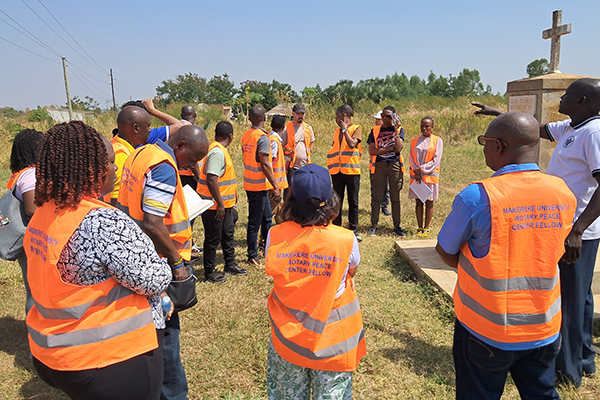
Apart from insightful academic lectures, field excursions make this program remarkably unique. Our trip to Rwanda deepened my understanding of the devastating consequences of the 1994 genocide, the powerful role media can play in either fueling violence or promoting peace, and the importance of ethical leadership, reconciliation, and responsible communication in preventing future atrocities.
We also traveled to Northern Uganda to meet with former wives of the rebel leader of the Lord’s Resistance Army insurgency from 1987 to 2006. The women are rebuilding their lives after enduring years of trauma, which reminded me that peacebuilding is also about healing and restoring dignity.
Turning point
During a lecture on the role of media in peacebuilding, I knew I had found an answer to my question of: “What next?” The subject was the concept and theory of Peace Journalism, and how it can be used to promote peace. Instantly, something clicked. I was very certain this was the right path.
As part of my social change initiative for the fellowship, I organized, mobilized, and trained senior superintendents of police, senior superintendents of prisons, and journalists on each other’s rights and responsibilities. We covered why press freedom matters, international protections for journalists, and how attacks on media erode public trust and electoral transparency. My initiative aimed to promote a lasting cordial working relationship between journalists and security agencies for sustainable peace and security before, during, and after elections in Uganda.
In previous years, elections in Uganda were marred by violence, harassment, and intimidation of journalists by security agencies. The situation worsened during the 2021 general elections. Security agencies particularly targeted journalists, and over 40 cases of these attacks were reported in the media and by human rights organizations.
My work contributed to ongoing efforts to address the problem, especially during a period of heightened political tensions surrounding Uganda’s elections. During our engagements, security personnel made a vow to provide a safer and more secure environment for journalists to do their work without intimidation or harassment.
Our efforts paid off. The 2026 general elections were largely peaceful. Only five cases of security attacks against journalists were recorded compared to over 40 reported in the 2021 general elections.
The birth of Global Peace Journalism Foundation
I have now started the process of fully registering the Global Peace Journalism Foundation. This was born out of a need to nurture a new generation of journalists who can use journalism to reduce harm and tensions and promote dialogue and social justice in communities.
As I take my peacebuilding to the next level, I strongly believe that peace takes work and collective efforts. I plan to use the global connections made during the fellowship and also engage with Rotary and Rotaract clubs in Uganda to scale my foundation’s work nationally and internationally. Peace journalism is needed today more than ever because conflicts, misinformation, hate speech, and polarization spread rapidly. Responsible reporting can help promote understanding, dialogue, and peaceful solutions.
I would encourage anyone who contributes to peacebuilding to apply for a Rotary Peace Fellowship. It offers more than just academic growth; it also offers global connections, practical experiences, and leadership skills needed to transform ideas into meaningful action for a more peaceful world.
Learn more about the peace center at Makerere. For International Day of Peace, 21 September, watch this video of Rotary Peace Fellows discussing how we build peace.
https://blog.rotary.org/2026/09/21/using-journalism-to-promote-peace-in-uganda/