


By Monique Chambers, partner of presidential aide John de Giorgio
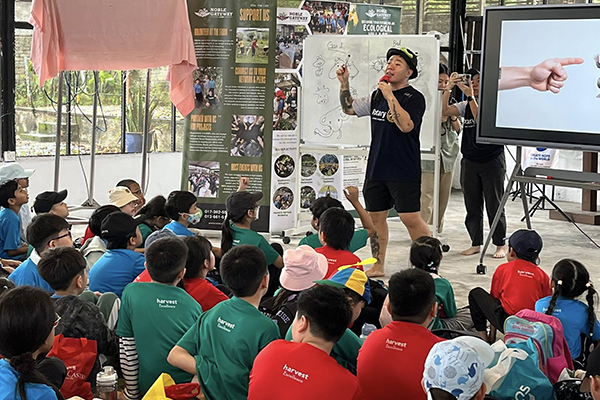
Handcrafted from sustainably sourced bamboo, the small gift shared with (Rotary International) President Francesco (Arezzo) and his aide was never intended to be merely a token of appreciation. This gift was a phone stand which doubles as an amplifier. And it certainly helped get our attention!
In presenting it to us, Sam Mok Hsu Wei, charter secretary of the Rotary Club of Hulu Langat Eco, Malaysia, in District 3300 said “This small gift was designed to spark a deeper conversation, one rooted in something close to our hearts: the urgent need to reconnect children with nature.”
In Malaysia, that connection is slowly slipping away. While many international schools embrace outdoor and experiential learning, the majority of students in government schools encounter science almost exclusively through textbooks. For many, soil is an abstract concept rather than something to touch, examine, and nurture. Biodiversity is something read about, not observed. The link between daily human behaviour and environmental consequence often remains invisible.
Even the arts, which historically draw so much inspiration from the natural world, are increasingly disconnected from ecological themes in public education. At a time when environmental awareness is most critical, this gap continues to widen.
It was within this context that the Rotary Club of Hulu Langat Eco, Malaysia’s first environment cause-based Rotary club, launched a pioneering global grant project titled Restoring Natural Order. The project is driven by a simple but urgent vision: to help children rediscover natural systems not through theory alone, but through hands-on experience, scientific exploration, and regenerative practice.
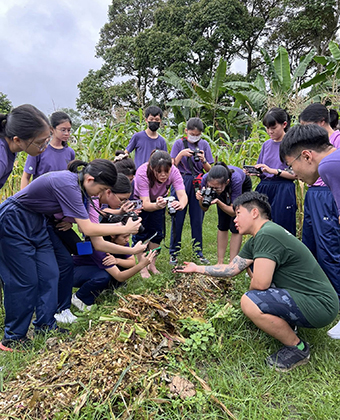
It’s a tremendous idea. The year-long programme integrates circular economy education, regenerative agriculture, microplastic science, soil health, composting, biodiversity observation, and behavioural change. Students and teachers take part in immersive workshops, guided experiments, regenerative gardening sessions, waste audits, and circularity simulations. These activities transform abstract sustainability concepts into lived experiences.
A key strength of the programme is collaboration. Through partnerships with experts — including the University of Nottingham Malaysia School of Pharmacy — students gain access to microscopes, scientific tools, and role models they would rarely encounter in a standard school setting. This exposure helps demystify science while encouraging curiosity, critical thinking, and aspiration.
The project also focuses on long-term impact. Hardware such as regenerative garden beds, composting stations, and waste-sorting systems is installed in each participating school, turning campuses into living laboratories. These facilities ensure that learning continues long after the grant period ends, embedding environmental stewardship into everyday school life.
The project is supported internationally by the Rotary Club of Taoyuan Alpine and designed with replication in mind. Upon completion, a comprehensive Standard Operating Procedure guide will be published, enabling Rotary clubs across District 3300, District 3502, and beyond to implement the model within their own communities.
As climate projections indicate the world may breach the 1.5°C threshold as early as 2027, today’s children will face environmental realities no previous generation has known. Restoring Natural Order is Rotary in action, ensuring that young people are not only aware of these challenges, but equipped with the knowledge, skills, and mindset to meet them.
Watch this video to see the project in action: https://youtu.be/NFYETLnAqDI
https://blog.rotary.org/2026/01/13/amplifying-impact-reconnecting-malaysian-children-with-the-living-world/