


By Md. Hemayatul Islam Arif, past president of the Rotary Club of Rajshashi Central, Bangladesh
I’ve always believed that the best Rotary projects are the ones that meet a community’s most urgent needs head-on. And recently, I witnessed one of the most timely and vital initiatives I’ve seen in a long time.
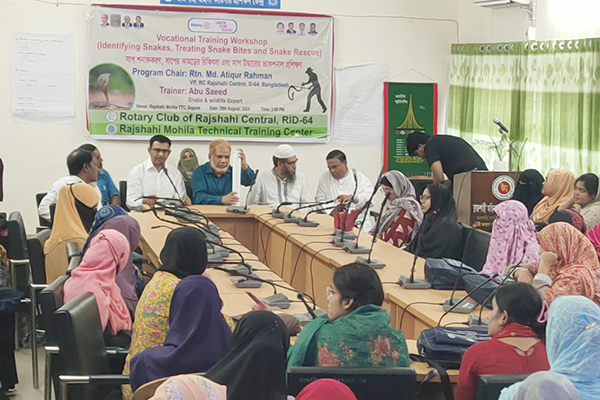
The Rotary Club of Rajshahi Central, in collaboration with the Rajshahi Mohila Technical Training Centre (TTC), hosted a vocational training workshop to train 50 women on snake identification, rescue, and bite treatment.
This wasn’t just an interesting topic — it was a critical response to a real and present danger.
Why the training was urgent
Lately, our region has faced a new threat. Floods have been carrying a particularly dangerous snake, the Russell’s Viper, from the Farakka Dam region into local communities. The risk of encounters has skyrocketed, and fear and misinformation can be as dangerous as the snakes themselves.
Members of the Rotary club decided to empower people with knowledge. The energy at the Mohila TTC campus was incredible. You could see the determination on the trainees’ faces. They were there to learn skills that could literally save a life — perhaps their own or a neighbor’s.
Md. Abu Saeed, a snake specialist from Dhaka, gave practical, easy-to-understand advice. He taught them how to:
- Identify common snakes, distinguishing between venomous and non-venomous types.
- Safely rescue a snake without harming it or themselves.
- Apply crucial first-aid steps for a snake bite before professional medical help can be reached.
The bigger picture: what Rotary does
This project is a perfect example of Rotary’s core mission. It was a collaborative effort that addressed a public health crisis through vocational training. As Mohammad Shofiqul Islam, Principal of the Mohila TTC, pointed out, these skills empower individuals to contribute directly to community safety.
The Rotary Club of Rajshahi Central saw a problem and mobilized its resources to create a solution. They built a partnership with a great local institution and brought in an expert to make it happen. This is how we build resilient communities — one life-saving skill at a time.
Fifty more women in Rajshahi are now equipped not just with technical skills, but with the confidence to be heroes in their own communities.
Dr. Md. Hemayatul Islam Arif is Deputy Chief Veterinary Officer for the Department of Veterinary & Animal Sciences, University of Rajshahi, Bangladesh, a member of the Bangladesh Livestock Society, and joint executive editor of the Bangladesh Livestock Journal. He has served his club as president, learning facilitator, and executive secretary/director.
https://blog.rotary.org/2026/01/27/life-saving-training-in-rajshahi/