


By Stephen Frantzich, Rotary Club of Parole (Annapolis), Maryland, USA
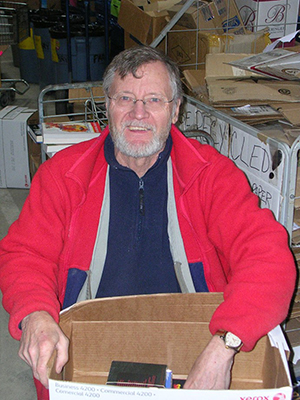
My stint as a Rotary Ambassadorial Scholar in the Philippines opened my eyes to the challenges of developing countries, whet my appetite for travel, and allowed me to complete my doctorate in political science.
Always oriented toward the power of books, I went on to write two dozen during my 40-year career at the U.S. Naval Academy. During my early years of teaching, I did not have time to join Rotary, but I made room for participation in 1995, joining the Rotary Club of Parole (Annapolis).
I was immediately drawn to the club’s project, Books for International Goodwill (B.I.G.). In the early years, we struggled to put together one shipping container every six months or so, but our goal of “keeping books alive” never wavered.
Over time, we developed a reputation as the go to organization for donating and receiving books. Leveraging help from non-members working alongside Rotary members, we developed a fine-tuned routine which allows us to collect, sort, pack, and ship an average of 10 containers per year.
Each 20-foot container includes anywhere from 20,000 to 25,000 books — virtually a library in a box. This is our 30th year of operation and we estimate that we have processed over 10 million books, funded by book sales and a small number of grants.
It all began with a letter from South Africa. The club had sponsored a young woman who was a graduate student at the University of Maryland. After she went back home, she wrote us to say she had some good news and bad news. The good news was that she had been appointed the principal of two schools. The bad news was that there weren’t any books. Could we gather some books for her? Our shipment of 20,000 books enhanced the ability of her teachers to develop student reading skills, and the leftover books were the impetus for continuing the effort.
Three decades later, the project continues to have a lasting impact. At Africa University in Zimbabwe, our books inspired an outreach program where students in education go into their villages to read to children. The educational training had largely been theoretical, but this added a practical application.
In the Democratic Republic of the Congo, a college was able to earn accreditation for a major in English, which they had previously been unable to because of a shortage of books.
Beyond enhancing literacy, B.I.G. has had a substantial impact on the environment, saving thousands of cubic feet of landfill space. Our local school district used to have to pay to dump books, and now come to us to have them distributed.
We believe that we are the largest volume all-volunteer book distribution project in the world. Our efforts not only support Rotary’s commitment to literacy, but also its environmental goals by keeping books out of landfills. Learn more about our efforts at www.big-books.org
Stephen Frantzich is president of Books for International Goodwill, based in Gambrills, Maryland, USA.
https://blog.rotary.org/2025/11/28/project-gives-old-books-a-new-life/