


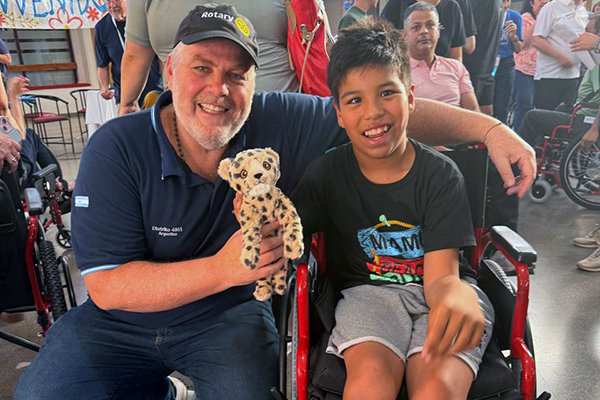
By Leonardo Gonzalo Mangoldt, 2025-26 governor of District 4851 (Argentina)
At the beginning of my term as governor, I realized that the main challenge in my district was not simply increasing membership. The real challenge was restoring Rotary’s relevance in our communities.
Our district covers ten provinces in Argentina and includes very different social realities: large cities, small towns, rural areas, and remote mountain regions. In many places Rotary had been present for decades, but over time some of the clubs had become insular, old, and resistant to change. In other communities, Rotary had disappeared altogether.
I observed something that is likely happening in many parts of the world. Clubs were trying to solve the membership problem by finding people to fill chairs at meetings. But communities are not looking for meetings — they are looking for meaningful ways to serve and belong.
That reflection changed the question for our leadership team. “How do we recruit more members?” became, instead, “How do we create more opportunities for service and belonging?”
This led us to take a different approach. We started visiting cities without Rotary clubs and organizing open informational gatherings with young professionals, teachers, entrepreneurs, and community leaders. In many cases, we discovered that the issue was not a lack of interest in Rotary but a lack of awareness. When people understood Rotary’s purpose and its impact, the response was immediate.
At the same time, we discovered small clubs of three or four members operating as a satellite club that were on the verge of collapse. For years, the tendency had been to keep these tiny groups alive. But instead of looking at these small groups as a failure, we looked at them as an opportunity. We sought to give each a new identity that would create service opportunities that would attract people to want to join. Changing the narrative was essential — the community saw the birth of something new rather than the loss of a club.
We also learned that sometimes Rotary already exists outside Rotary. After meeting with health and education professionals, we realized they already had a network and a desire for service. All they needed was to be drawn together as a Rotary club. This led to the creation of our first issue-based e-club.
For very small clubs, we worked to set concrete membership goals and provide close district support. Once a club has visible projects and its board feels supported, the level of motivation within a club returns. Membership does not grow through weekly meeting attendance; it grows around meaningful impact.
Even conflict sometimes presents opportunities. In one instance, a long-standing clash of viewpoints led us to create a new club, letting new leaders emerge and expanding our presence in the community instead of forcing a solution on the “problem.”
So far, we have formed eight new Rotary clubs and three Interact clubs. Rotary has returned to communities where it no longer existed.
But the most important lesson was not numbers. It was this. Communities have a deep desire for service. People want to help, participate, and belong to something meaningful. When Rotary offers an open and safe place to do that, membership grows naturally.
https://blog.rotary.org/2026/03/26/restoring-rotarys-relevance-in-communities/