


By Simbarashe Basvi, Rotary Club of Ladner, British Columbia, Canada
On 30 April, I returned to my former primary school, Chamukwenjera, in Manyene, Zimbabwe. Manyene is a rural communal area on the outskirts of Chivhu, about 150 kilometers (93 miles) from the capital, Harare. The last time I was there was in 1989. I was a young boy, dreaming of a future that felt both fragile and far away.
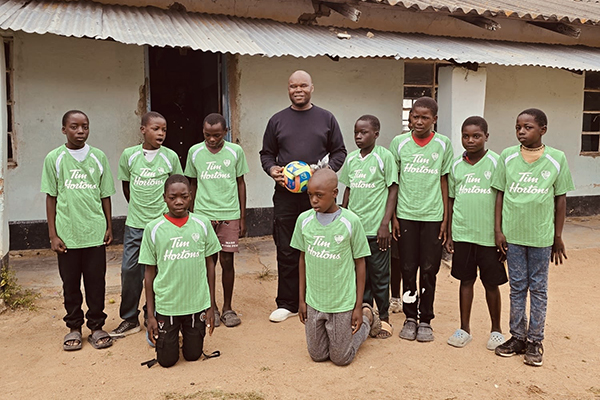
On this trip, I was delivering about 300 soccer uniforms and some soccer balls generously donated by the Rotary Club of Ladner. The journey was a powerful reminder of why Rotary exists: to uplift, to restore dignity, and to serve humanity.
Harsh reality of rural education in Zimbabwe
Rural families in Zimbabwe face immense challenges in accessing education:
- Many children walk long distances, often on empty stomachs.
- Parents sacrifice livestock or harvests to pay exam fees or buy uniforms.
- Some children drop out because the family simply cannot afford basic supplies.
Schools themselves are severely under-resourced. They face:
- dilapidated classrooms with cracked walls and broken windows
- a shortage of desks, with three or four children sharing a single desk
- a scarcity of textbooks, with ten students sometimes sharing a single book
- a lack of access to water or toilets, compromising sanitation and dignity
- teachers living in precarious housing, often without water or electricity
Yet despite these hardships, teachers continue to serve with passion, and children continue to learn with determination. Their resilience is inspiring.
Standing in my old classroom
As I walked into my old seventh-grade classroom, I felt like I was stepping into a memory frozen in time. The walls were the same, the desks were the same — some of them were the ones we used in the 1980s. There was also the same dust and smell of chalk, and the same spirit of hope in the faces of the students I saw.
The students were deep in their Holiday Study Programme. Some were barefoot. Many looked hungry. But their eyes were bright, full of ambition and possibility.
I stood where my seventh-grade teacher once stood, remembering how I would shade those tiny circles on exam papers, each one a small declaration that my future mattered. So, I shared with them that their background does not have to define their destiny. They may have doubts and fears, but these would not be the final word. Something good can come out of Chamukwenjera.
Personal reconnection
The trip also reconnected me with rural life and its many challenges. I fetched water from a borehole 5 kilometers away using a wheelbarrow, just as many families do daily. I used my plumbing skills to help a family install a water tank, giving them a more reliable water source. And I harvested maize, groundnuts, and small grains at our family plot, a reminder of the importance of food security.
These experiences grounded me, reminding me that service is also about presence, empathy, and shared humanity.
Reflecting Rotary’s core principles
While the donation of soccer uniforms may seem like a small thing, in a rural community, it can have a profound impact. I see our project aligning with many of Rotary’s principles and areas of focus.
- Supporting Education & Community Development. Uniforms restore dignity. They give children confidence. They help them feel seen, valued, and included.
- Empowering youth. Sport keeps young people engaged, disciplined, and focused. It protects them from harmful influences, including the rising drug menace affecting Zimbabwean youth.
- Community Economic Development. A strong school builds a strong community. When children stay in school, the entire village benefits.
- Promoting Peace. Sport unites. It builds friendships, teamwork, and mutual respect, essential ingredients for peaceful communities.
- Service Above Self. This donation is a practical expression of Rotary’s motto. It is a service that uplifts without expecting anything in return.
- Creating Hope in the World. Rotary’s global theme resonates deeply here. These uniforms are not just clothing; they are hope stitched into fabric.
Our donation helped restore dignity, It encouraged school attendance and participation, strengthened community pride, and supported teachers. Perhaps, among these children are future Rotarians, young leaders who will one day serve their communities with the same spirit of generosity.
A future full of possibility
I am greatly thankful to Mike Storey, a member of our club, who went above and beyond to source the uniforms. This trip would also not have been possible without our entire club, whose members contributed through coordination, encouragement, logistical support, and simply by believing in the project’s value.
As I left, I carried a mixture of pride and pain. Pride in how far we have come. Pain for how much still needs to be done. But above all, I carried hope. Hope that these children, hungry, barefoot, sharing textbooks, yet fiercely determined, will rise. Hope that our small acts of service will ripple into generational change. Hope that Rotary will continue to be a beacon of dignity, opportunity, and compassion.
And going back to my roots reminded me why we serve: Because someone once believed in us, and now it is our turn to believe in them.
As the 2026 FIFA World Cup approaches, read what Rotary clubs are doing to welcome visitors and showcase Rotary.
https://blog.rotary.org/2026/06/09/soccer-uniforms-restore-diginity-hope/