


For World Food Day on 16 October, Rotary Peace Fellow Elaine Pratley reflects on what happens when we gather around a table…and notice who’s still missing.
I’m a peacebuilder, and this is my confession.
After years of researching “food peacebuilding,” I decided to put my research into practice by helping people connect across differences and divides through my favourite language: food.
Peace Kitchen was born in Melbourne, Australia, as a way of creating experiential dialogues about all sorts of topics, with food as our signature methodology.
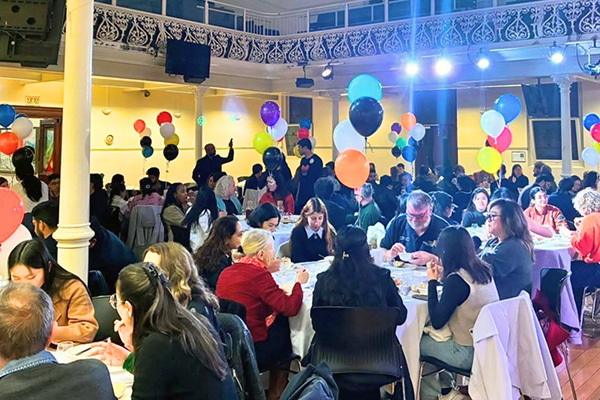
While we had organised many Peace Kitchen dialogues over the years, this latest one in August was special. We wanted to help people break out of their normal social circles.
In one of the world’s most multicultural cities, it can, ironically, be hard to meet folks outside our normal socio-economic groups.
I thought the hard part of bringing 150 people together for this Peace Kitchen dinner would be getting 150 people to show up. I was wrong.
We filled every seat within days, including with Rotary members from District 9800 (Australia). There was a real hunger for meeting people outside our usual bubbles.
The harder part was the actual food
Working with food is a bit like trying to decode an adolescent’s grunt. Tread carefully!
Vegetarian. Vegan. Halal. Allergies. Intolerances. Foods people love, foods they avoid, and foods they simply cannot eat.
Frankly, I spent an inordinate amount of time thinking about what could go on everyone’s plate before anyone had even sat down.
But the more I looked around our Peace Kitchen dialogue, the more I realised that dietary requirements were only the beginning.
Despite deliberately trying to create a welcoming space and inclusive table, there were still plenty of people missing.
Our event was on the second floor. We had invited people with disabilities, but the venue itself made it difficult for some people to participate.
An invitation only goes so far
We were holding Peace Kitchen above a Salvation Army soup kitchen. While we had invited people using their services to join us, no one did.
Not because they weren’t welcome.
I found myself wondering whether the room felt like it was for them.
Would I walk into a room of 150 strangers if I wasn’t wearing the right clothes, or didn’t have the confidence or the kind of life experience I thought belonged there? Especially when most of my energy had gone towards getting through the day? Hmmm…
I also thought about the disposable cutlery.
We were bringing 150 people together to talk about peace, connection, and the world we share. Yet the sheer size of the event meant using disposable plates and cutlery.
I wasn’t thrilled about the waste, but it was the most practical option within our means.
As someone who spends much of my working life thinking about how we create spaces where people can connect across difference, I feel these contradictions keenly.
But perhaps that is what I love about food. It makes the contradictions of our world difficult to ignore.
The plate tells the story
Look at almost any meal closely, and you can see much more than what’s on the plate.
You can see poverty in who grows our food and who can afford it. You can see gender in who is expected to cook, care, and feed others. You can see environmental questions in the water, soil, energy, and waste behind a meal. You can see migration and identity in the foods people carry with them, adapt, and share.
And then there is the possibility of peace (imperfect, incomplete, but nevertheless real) in what can happen when people who might otherwise never meet sit down together.
At Peace Kitchen, 150 people from different countries, faiths, and professions shared a meal. They arrived with different experiences, assumptions, and stories.
The dinner didn’t solve poverty. It didn’t make our venue accessible. We still created waste. We still held multiple, perhaps even contradictory, viewpoints.
But something did happen.
People who might never otherwise have crossed paths had a reason to sit beside one another. They heard stories they might not normally hear. They discovered things they didn’t expect about people they had just met.
And perhaps most simply, they were reminded that despite our social, cultural, economic, and political differences, we all need to eat.
That is why I keep coming back to the humbly-shared meal as a tool for peacebuilding.
Rotary members and Rotary Peace Fellows already know the power of gathering around a table. We do it at club meetings, fundraisers, conferences, community events, and at our Rotary Peace Centers. We call it fellowship.
Other questions we could ask
But I wonder if we can ask a little more of our tables.
Who isn’t here…and why?
Who can’t physically get into the room? Who can’t afford to participate? Who has been invited but still doesn’t feel like they belong?
And once we notice, what could we change?
For me, that is part of what building peace looks like. Not creating a perfect table where everyone agrees and every problem has been solved. I’m not sure such a table exists.
Perhaps it’s more about noticing who is missing. Being curious about why. And then asking what we can do to make a little more room.
Because food does more than nourish us.
It connects us to the planet, to the systems that shape our lives and, when we share it, to each other.
This World Food Day, perhaps the question isn’t simply what’s on our table? Perhaps it’s who gets a seat at the table…and who gets through the door in the first place?
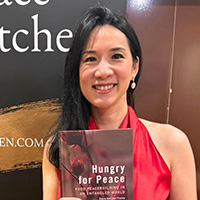
About the author: Dr. Elaine Pratley is founder of Peace Kitchen, a Rotary Peace Fellow, and author of Hungry for Peace (Edinburgh University Press, 2026)
https://blog.rotary.org/2026/10/15/what-food-taught-me-about-inclusion-belonging/